Gamification for attractions, what is it?

A roller coaster is not a game. A castle dark ride is not a game. The Hogwarts Express, the Tower of Terror, the Avatar floating mountains, every parade and pyrotechnic show ever built none of these are games. They are extraordinary works of themed entertainment, ride engineering and theatre, often by the most talented designers in the world, and they have given joy to billions of people across seventy years of the modern theme park industry. They are also, almost without exception, things that happen to the guest rather than with the guest.
This is worth saying clearly because the word gamification gets thrown around in our industry with a fair amount of slippage. It is sometimes used to mean any kind of fun, sometimes any kind of interactive technology, sometimes anything involving a screen. None of those are right.
Gamification is the application of game mechanics goals, choice, feedback, progression, rewards, social comparison to environments that are not themselves games. That is the working definition. The mechanics are well understood, having been refined across decades of video game design and online communities, and they map onto an extraordinary range of environments: corporate training, fitness, education, retail and, increasingly, themed attractions and immersive entertainment.
A theme park overlaid with gamification is still a theme park. The rides are still rides. The shows are still shows. The food is still excellent (or, in some parks, defiantly mediocre gamification cannot fix everything). What gamification adds is a layer a quiet, persistent, addressable layer that knows who each guest is, what they have done, what they are working toward, and how to reward them when they do something interesting. That layer can be invisible when the guest does not want it, and visible when they do. It is not a replacement for craft. It is a multiplier on craft, enhancing guest engagement, supporting personalized experiences and enriching the overall guest experience.
The clearest way to see the difference is to think about the role the guest plays. In a non-gamified park the guest is, fundamentally, an audience member. They board the ride, they watch the show, they queue, they exit. The role is spectator. In a gamified park the guest is also a participant. They are the protagonist of a story that progresses across multiple attractions. They are the hero who defeats the antagonist. They are the explorer collecting the rare relics. They are the team captain whose family ends the day on the leaderboard. The themed entertainment surrounding them does not get smaller, it gets larger, because they are a driver of the action, creating story-driven experiences and memorable interactive experiences that extend across the guest journey.
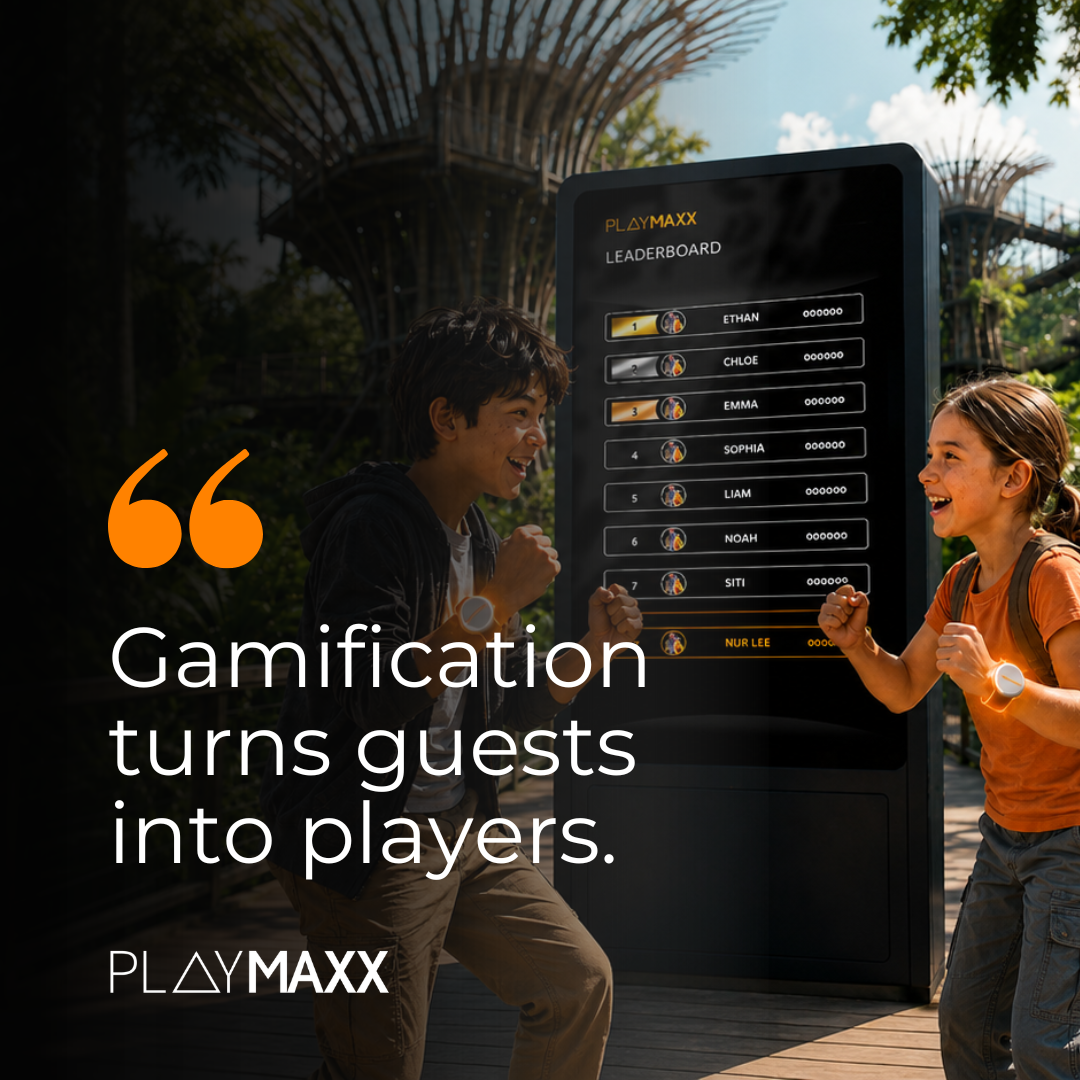
Mechanically, the overlay is delivered through technology that is, at this point, unremarkable. A guest wears an RFID wristband or carries an NFC-enabled phone. They tap on readers hidden inside themed props a stone tablet, a control panel, a treasure chest and the platform recognises them, advances their story, lights up a screen, plays a sound, unlocks a video, awards points, opens the next zone. Cameras, motion sensors and other triggers fill the moments where a wristband would break the spell. A player profile tracks every interaction across every attraction, in the park and beyond it, enabling visitor analytics, engagement metrics, real-time guest engagement and increasingly data-driven operations for park operators.
The reason this works at theme parks specifically and not, say, at a museum or a cinema is that theme parks are already built around immersion. The sets are real. The world is consistent. The narrative scaffolding is in place. Gamification slots into that scaffolding the way a mod slots into a finished game: it does not invent the world, it gives the guest something purposeful to do inside it. The result is a blend of digital + physical experiences, sometimes described as phygital experiences, where gameplay and attraction technology deepen immersion rather than distract from it.
Universal's Galaxy's Edge Datapad and Disney's MagicBand are early-generation examples of exactly this competent, well-loved, but in both cases stitched into parks that were originally designed for a passive guest. Warner Bros' soon-to-open Riyadh park, built with gamification as foundational infrastructure rather than a bolt-on, is a glimpse of the next generation of playable attractions, gamified experiences, and interactive entertainment within the wider location-based entertainment (LBE) sector.
Gamification, properly understood, is not a competitor to themed entertainment. It is what themed entertainment becomes when the guest is invited to step inside the story rather than watch it go by. The result is stronger guest loyalty, increased repeat visitation, and a new category of playable attractions that sits at the forefront of entertainment innovation. The rest of this series is an examination of what that means in practice for guests, for operators, for designers, and for the technology that makes all of it work, and what it may mean for the future of playable attractions.
Related Posts
How we’re mixing things up

How AI is supercharging gamification & immersive experiences